Call for submissions: Jörð devotional

I am going to be compiling, editing and releasing a devotional through the Troth! I am seeking out work written in honor of the Earth through a Heathen perspective, by the various names she has in our traditions. Devotional works in honor of the land are also welcome.

I am placing particular emphasis on poems, prayers, and rituals, but artwork would be enthusiastically accepted as well!

You do not have to be a member of the Troth to submit your work, just bear in mind that because we are publishing through them, any submissions have to comply with the Troth’s stance on inclusivity. We will also be asking for first publishing rights in North America. This means that the Troth has the right to be the first to distribute your contribution—after that, you can republish your work with no restrictions. There is also a release form to sign, which I will provide.

Please also bear in mind that contributions are not paid. All proceeds from sales of the published devotional will go towards Red Hammer, which is the Troth’s disaster relief fund.

Contributions can be emailed to peaksinmay AT Gmail DOT com. Submission deadline is December 31st, 2022, with the goal of releasing the finished book in April.

Wealthy in Each Other’s Company

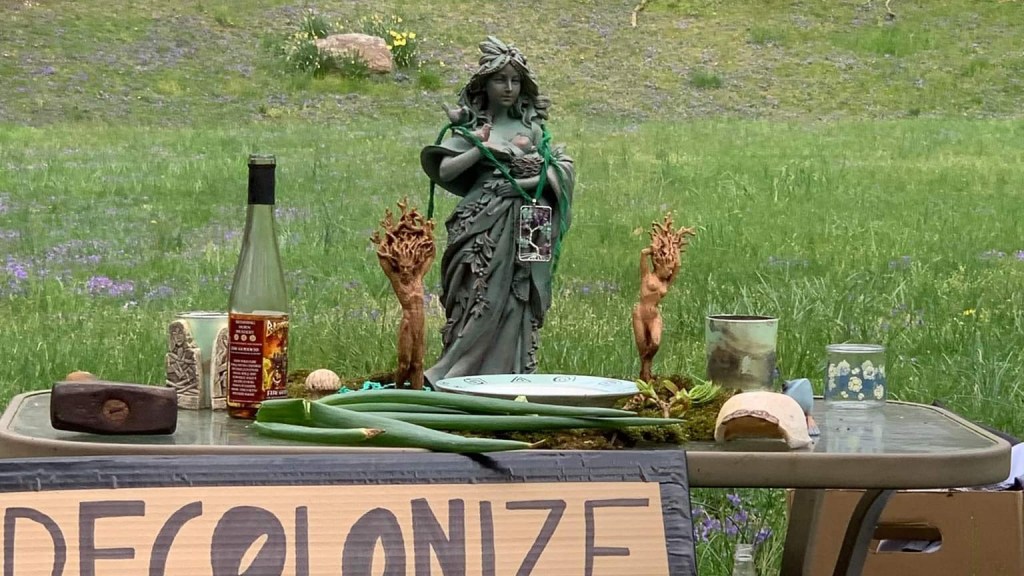
For three years now, I’ve been hosting a ritual to Jörð on the Saturday before Earth Day.

Photo by Robert L. Schreiwer

At first, the motivation behind these rituals was a bit selfish. Finally realizing the severity of the climate crisis was crushing, which should be unsurprising given that it is literally the biggest threat ever posed to living things on this planet. I vividly remember laying face-down in the dry clay, alternately crying when lucid, and dissociating when not. Even a few minutes earlier I would have still found the phrase “dirt-worshipping Heathen” obnoxious, but I couldn’t exactly act like this wasn’t a fair accusation now.

The thing is, this existential fear isn’t new. It was only new to me. And the reason it was new to me was because whiteness and my family’s class status had insulated me from having to actually confront it. I can buy my life off the shelf if I so choose, enabled by colonial government and exploitative industry. This crisis has been ongoing for literally everyone else, for hundreds of years.

This sense of interconnection that the looming threat of climate change brought me should have been intuitive. But the world built on my behalf requires being separated from the earth. The comparatively new sense of a sprawling, tangled web of fate under my feet filled me with cold-muscled fear.

Like most people who crack under the strain of pretending to cooperate with absolute bullshit and feeling like everyone else knows something you don’t, I brought it to therapy. My therapist tried his damndest to instill some hope in me for life on earth—namely Lif and Lifthrasir as a metaphor for plastic-eating, thermophilic microbes, should they evolve in our absence. But none of this took away from the core fear that the world is ending for real.

In part because I already associated the events in ragnarök with the carbon cycle, I decided that the way to cope with my eco-anxiety would be through designing rituals again. This time, something heavily inspired by Völuspá.

Initially, what I had in mind had zero resemblance to the way I do Jarðarblót now. I had originally contemplated something theatrical, angry, and involving fake blood and scorn poles. I still have the unfinished papier-mâché horse head on a shelf in my closet. But eventually, something clicked.

Continue reading “Wealthy in Each Other’s Company”

Putting On My Silver

I didn’t get what I wanted.

Or thought I wanted. I dared to ask Freyja for help with romantic success, because I had been harboring a crush for someone for years, plural, by this point. Raising my elderflower and rose lemonade, I asked her for the courage to try and get what I want.

When I got home after that ritual, fiddling with the little copper-colored Mardi gras beads, I elaborated on what I wanted: give me the confidence to take the risk of asking them out. I will get you a nice necklace.

She filled my head with bizarre dreams, and I bought her an amber pendant that resembled a drippy honey comb. Unbeknownst to me at the time, they were already well on the way into a partnership. I didn’t find out until several weeks later.

I didn’t call it heartbreak, but it knocked the wind out of me.

When I had finally gotten some energy back and I wasn’t calming myself by obsessively mowing the lawn, I railed against this perceived injustice, all the while knowing I still wasn’t ready. I didn’t actually want to be partnered, and certainly not with someone who didn’t want me. I had gotten into heated arguments with my therapist explaining as much. Vulnerability is agonizing. I am traumatized in ways I am still picking apart. Irrespective of whether I feel it’s ethical for me to bring this to a partner (and I don’t), I didn’t want to be in a position of risk.

It still felt like this was something being done to me. I felt like I had been lied to by Freyja, given symbolism in dreams that sang of interpersonal potential. Divination had been promising. I never felt the need to suspect any other outcome because we were making such good progress…I felt confident. And I had asked for confidence, right?

Continue reading “Putting On My Silver”

In Which I Pretend Not to Take Myself Seriously for 1,270 Words

I started taking myself seriously as a Heathen blogger about four years ago, with my February 2018 post “The Geology of Ragnarok.” I don’t know for sure if I still stand by that post, especially now knowing that Fimbulvintr probably described a volcanic winter rather than an ice age, but it did show the very early inklings of a Heathen practice that would strongly emphasize the carbon cycle–and the disruption thereof.

When I made my pledge and then started taking myself more seriously as a Heathen, in general, I spent more time with the text than the emotional aspect. And then, as an admin in a Lokean group and trying to handle that relentless shitshow, being curious about the thought processes and motivations for why they kept fucking happening. This is probably where I started to have a recognizable niche, because these posts performed ridiculously well and one of my search term hits is “tumblr Loki Lokeans.” Ironically, most of the teachable moments came specifically from the Facebook group. If I was critiquing behavior on Tumblr, it was probably limited to spongecakegate, astral babies, or I was using it for window dressing.

For some reason, the founder of that group referred to my blog as “useful,” which to me reflects a frightening lack of self awareness. Which is the number one most annoying behavioral tendency I’ve seen in Lokean groups.

Anyway.

As I took up an interest in anarchist theory–or maybe began to recognize I was sort of on the way there anyway, and decided to actively cultivate that outcome–I fancied myself an essayist for a minute or two. My writings about Heathenry became more longform, more critical, more interested in making a case for how Heathenry might create a freer, safer world–but mostly tearing into it for the way it was failing to do so because “inclusive” Heathenry would rather rest on its laurels.

This is the number one reason that Heathens and anarchists both annoy me, which is a nuisance, because I am still a Heathen anarchist. It turns out “you’re doing it wrong, you’re not the boss of me” is a pretty reliable tendency in both categories and it’s a small wonder they overlap.

Why even blog about Heathenry?

I can’t shut up. I love to complain, way too much. Maybe it’s a culture thing I picked up from my family. Talk about the plight of a distant cousin over some Yuenglings. Talk about the most terrible thing you saw on the news, over some Yuenglings. Bitch and moan. Yuenglings optional.

Usually I would have a can of seltzer nearby while writing, anyway.

But I also grew up getting yelled at for complaining a lot, and I don’t know if it was unfair judgement of a really sad kid (because I was a really sad kid) or if I really was that whiny. So when I feel the urge to complain, I reflexively try to connect it to a broader context, as if I am trying to justify why I take issue. I know, rationally, that I can just not like things, or behaviors, or people. But as you might imagine, I’m on the defensive by default.

And often, the behavior that troubles me is maybe normalized in the particular setting where it’s showing up, but it’s just so goddamn unhealthy and obnoxious that I don’t feel like I can get away with simply Not Liking It. If the behavior is driving clever and promising people away, if it’s exhausting, if it enables oppression, if it doesn’t help anyone but the person misbehaving, it’s bad behavior.

So I try to make my complaining…helpful. And it seems, by and large, that people have found those kinds of posts helpful. Which is nice to know.

But it got really tiresome after a while. And so, even when I had the time, I was constantly getting stuck on posts. I have no shortage of ideas, I have 55 drafts at the time of this writing (which naturally includes this post). But I couldn’t finish one to save my life. I felt like I had lost the ability to stick to the expectations that I had created. I figured that either what I did publish would be overlooked (a realistic fear, because that repeatedly happens), or it was at risk of being nitpicked at. I felt like I had peaked. And maybe I have, because changing the blog name certainly didn’t do me any favors.

Once or twice I would dig out an old post that I felt didn’t fit, and would publish it anyway because it was still ready to go, and at least it was something. And it doesn’t feel great because I have gotten accustomed to taking myself seriously. Which is a little weird for a Lokean.

Although I do wonder now and then if I still can or should call myself a Lokean. While Loki is officially one of my primary deities, and he’s the only one I have any active sworn responsibilities to…I do very little. And I mean, very little. I am technically in violation of my pledge more often than not because I can hardly claim to be helping my community or pursuing ordination to the best of my ability. I am, however, being very good about making sure my shrines are cleaned off once a month. Because if I don’t, they will collect dust for months.

The thing about the pledge is it was kind of like having a baby to save a marriage. (Not an actual marriage, by the way. I am not a godspouse.) I was slacking really badly at the time that I made it, and I thought it might help light a fire under my ass. And I was right, initially. I threw myself hardcore into lore research and various volunteer opportunities. That’s a big part of why the nature of my blog shifted the way it did.

And then I very predictably got unfocused again. I initially typed “lazy,” but this was in the context of The Plague coinciding with me starting a steady job, which became a steady but horribly destabilizing job. The worst period of my life was age 16, but the first year of covid is a very close second. I am not “lazy” for becoming unproductive under these circumstances. But it did mean that my level of compliance dropped sharply.

I want to believe that it’s been politely overlooked, given the various situations. But it has become one more thing I tell myself I’m not doing well enough.

And anyway, my practice has expanded to the point that Loki is still central but definitely does not enjoy the degree of emphasis that he was probably accustomed to.

I keep announcing that I want to be less serious, as if this is an effective way to talk myself into it (it is not!), and my therapist has been trying to urge me to loosen up to the best of my ability for three years. And it’s not like I haven’t made progress, but it’s not like I’m making the progress that I would like to make, either.

I feel like almost every paragraph here starts with “I.” Something that I find terribly embarrassing. Maybe unreasonably so. If I’m the person who makes all the content (and I am), and if this blog was always supposed to be about my practice and my opinions and values (and it is), I might have to reach the conclusion that it’s only reasonable if I focus on myself and admit to doing it.

I guess.


Speaking of being self-centered, you’ll notice that there’s a Ko-Fi button at the bottom of most posts now. This links to my tip jar. In addition to blogging, I also write rituals for the public, which takes time and sometimes money. Tips help me justify the fact that I do this.

Buy Me a Coffee at ko-fi.com

Kingdom Hall Hates Them! Philly Heathen Gets Witnesses off Their Porch with This One Weird Trick

As much as I can’t stand the beliefs the Witnesses have about women and homosexuality, it was the highlight of my week if they showed up at my door because we could talk theology. I live for that. I love to analyze the source material of one’s faith and figure out how to interpret it.

But you do have to find a way to make them leave, eventually. And it would be really nice if you could keep them from coming back.

Some people try to drive Witnesses away by being scary and obnoxious, like showing up at the door with firearms. Or snakes. Or no clothes. Or burning Bibles, and making stupid jokes about blood-orgies and eating babies.

This doesn’t work. The Witnesses are trained to expect this when they’re sent out to preach. Usually they (correctly) decide that someone doing this is being an edgy jerk. And then they (understandably) decide that maybe you need Jesus a little more than they thought, and offer to replace the KJV Bible you burned with a NWV translation.

Also baby-eating jokes smack of Blood Libel so…don’t do that.

What does work, however, is preaching right back at them. Pagans take a lot of pride in not evangelizing, but in this situation? Screw it. They came to your house, knocked on your door and asked for your time.

And I’m not saying to pick apart the Bible with them. You’re a Heathen. The Bible is none of your business. The Bible, or at least one specific translation of it, is very much the business of the Witnesses. They’re the ones reading it and following weird interpretations of it on the regular, not you. Plus, they’re already trained to expect resistance, and they’re not playing by the rules you expect.

Play your home team advantage. Set the rules. Talk to them about Heathenry and don’t let them get a word in edgewise. Annoy the hell out of them in any other way you like, but be pointedly, flamboyantly, unapologetically Heathen about it.

When they try to bring you the good news about Jesus, regale them with the tales of Odin sacrificing himself to himself to get runes. Revel in how metal this is, of course, but talk their ears off about it.

If they speak about your fate at the end of the world, gleefully explain to them that the two survivors of Ragnarok are pre-assigned, and you aren’t one of them. Neither are they. And, hey, maybe Ragnarok already happened, so none of this really matters and you don’t have to worry about the consequences of being swept up in the ultimate fate of the world.

Your porch, your rules.

If they approach you in the street, and you do not successfully get them to ignore you, make it aggressively clear that you are a dirty fucking Heathen.

The thing about Jehovah’s Witnesses is that–on top of believing that lifesaving technology like blood tranfusions is against their god and that women aren’t people of any real worth beyond their uterus–contact with the world is spiritually hazardous. Just talking to you, a non-Witness, puts their souls in danger.

Which is fascinating, because the call to minister to the outside world is also compulsory. You’re required to endanger your soul to save it. But also it might not do anything. And also some people are more dangerous to your spirit than others.

But what that also means is that, for you, a Heathen, reading your favorite piece of common-sense advice out of the Havamal and repeatedly, helpfully reminding them that this advice is attributed to Odin will drive them off your doorstep. Quickly.

It also means that if you do it enough times, they blacklist you. You can get banned from being preached to by the Witnesses.

I discovered this completely by accident, because they haven’t come around in over five years and I was trying to figure out why. It’s kind of a bummer. The local Kingdom Hall is pretty close by. It’s not like it’s hard for them to come see me.

They just really don’t want to.

Buy Me a Coffee at ko-fi.com

Uprooted

I finally started hitting the local trails, now that I was somewhere that trails existed again. And while going through a dedicated tree identification loop on the trail I was struck by something.

I envy the resilience of the beech tree.

Or perhaps not the resilience, but rather, the chance at having resilience and the sense of home.

The beech tree is situated in a network of others of its kind, connected by roots and symbiotic fungus which transmit information and nutrients. I envy how trees in the shadow of their parents are protected, growing slowly for decades until the parent tree collapses and surrenders its sunlight.

I am very quick to recommend The Secret Life of Trees by Peter Wohlleben, and perhaps this is why I am zeroing in on beech when I go hiking, when I am not spotting hornbeams so quickly it feels like they’re flagging me down. Because these were the examples I got to see exemplifying things that I was approaching, but had not reached.

Trees raise their children. They feed their neighbors. But it’s not because trees are Just Like Us. Rather, we were once trees and we were forced to forget.

And I wish we remembered more, especially when I see how, despite nearly being wiped out by disease, beech have managed to reclaim woodland that was once cleared at the rate of an acre a day to feed a furnace. And in their shade the undergrowth is rich with ferns and moss, and lush with leaf litter, their repayment to the land that holds them in place as they reach skyward. They are in community with maples and oaks and the occasional pine. And if you successfully get deep enough into the forest, the wind in the leaves feels like watching waves flutter from below.

This is the closest I can find to a place where I feel safe, even as the silence around me implies the presence of a predator–probably me.

Beeches, and other trees in forests, have a literal rootedness that I do not, cannot ever have. That I can only seek out a substitute for. Which I will always be frustrated by.

If I am lucky, I wonder if I will grow to be the tree at the trail entrance that is scarred with carved initials and profanities, marked by someone’s desire to express a sense of ownership.

In June I left the house where I had lived for 27 years. When my parents bought their new house in December of 2020 I stayed behind as a caretaker, not wanting to leave my job that was barely paying for itself and having gotten sick to death of living with them. This ended up being perfect timing because I was exposed to covid at work just a few weeks later. I marked the solstice with a massive pineapple and anchovy pizza and explaining to the delivery guy, through the glass door, on the phone, that I could not open the door.

As I’m writing this it’s almost Christmas again. A holiday that I do not celebrate. A holiday that I successfully, completely avoided for the first time last year because I could not take visitors. The holiday I now cannot avoid because everyone else I live with celebrates it.

I do suppose, however, that it is super fucking recon of me to give in to my mother’s insistence on buying me things I need but cannot currently afford, because Christmas. I am back in circumstances where I am able to receive assistance and care that I have needed but kept putting off.

But I do not feel rooted.

I felt exposed in the city. I did not realize the extent of my emotional attachment to ambient plant and animal life until it was reduced to pigeons, badly behaved pandemic puppies, baby trees choking in pavement and the stubborn sycamores further south that simply ripped their way through decades ago. And I admired those sycamores because they had something I didn’t. I am stubborn and I am resilient, but unlike with sycamores, these are not pushed along by a will to live.

And what little I had was rapidly deteriorating in the city, where I felt constantly overstimulated with no way of turning away from anything. Sometimes Rob would have to scoop me up and take me out to the graveyard, or to East Earl, where at least the absence of trees was compensated for by farmland.

Now I am in a new location with a painful sense of being right back where I started. I don’t know how much of this inability to settle is self-inflicted bullshit, versus honestly earned suspicion.

But at least there are trees. There is at least one place where my shoulders can drop and I can catch a breath.


Buy Me a Coffee at ko-fi.com

Well, hello again.

When last we met our protagonist, it was December of 2019, before a plague hit the world and made life really fucking difficult.

Thankfully I just got my booster for the vaccine against that plague, so things will be marginally less difficult.

I had originally taken a sudden hiatus to focus on landing a job, write some more rituals (there was a Seasons of Transition III planned), and write blogs regularly again once I had gotten my rhythm back. The county shut down, my workload drastically increased, my friendship with my co-author ended, and I was under the worst stress of my life.

And then I quit my job that was supposed to be better than the last job and failed me yet again, moved out of a house I had lived in for 27 years, had a mental health crisis related to moving, got told to move out, MOVED AGAIN, and now finally have something vaguely resembling stability. Or at least familiar instability. Which was the environment I was writing in to begin with, so I guess it won’t be a hindrance.

Or I hope not.

I kind of backed myself into a corner for a while with my writing, because I was getting very used to ~teachable moments~ type shit and essays where I was trying to prove a point. And I don’t necessarily regret writing any of it because I stand by most of it, but at the end of the day I was getting sick of myself, and also ineffectually trying to impress people.

I mean, I was getting the response I wanted from certain people, but also, no, I wasn’t. The lack of self-awareness I was criticizing ran so deep that people I was literally describing were recommending my blog. And I cannot begin to tell you the kind of emotional exhaustion that left me with. It was very clear that nothing I was doing mattered and I no longer valued whether people liked it.

Also, a much pettier complaint, apparently you cannot make a case for why cute people should people fall in love with you by being smart. You have to be their type, and also actually tell them you like them. It’s so fucking complicated.

To try and resolve that sense of constriction, I’m going to give myself permission to be a lot more casual about my writing. I used to have content ready to go every week, or every other week, but it was because I had more free time and I wasn’t freakishly stringent about what I was putting out. And I am realizing being stringent was completely unnecessary, because I am running a pagan blog, where the formula for success is “confidence, irrespective of accuracy.”

That, I cannot get myself to do, but it means that the margin for error is far wider than I was willing to occupy. I am a hardass to myself first and foremost.

It’s not the worst tendency in the world, because a lot more people could stand to be much more self-critical. But I’m an anxious dumbass and was intensifying that behavior every time I got frustrated with people I thought should be more self-critical. Like I thought it would trickle down or something.

That is absurd.

We’ll see what happens. For now, I’m seeing how I adjust to this move.


Buy Me a Coffee at ko-fi.com

Why I Schedule Devotional Work

Executive dysfunction sucks.

You can spend the entire day working and yet get nothing done. Either you work doggedly with no progress on a singular thing you keep drifting away from, or you get literally everything else done, but with nothing crossed off your actual to-do list to make you feel accomplished despite your clean house.

Case in point, while writing this post I made dinner, emptied the dish rack, painted my nails and then saw my post outline and kicked myself.

And then kept painting my nails, while being upset with myself, as if this was going to change anything.

I was diagnosed pretty early in the game with ADHD. If not much else, it helped me sit with that information long enough that I’m able to be at least a little self-compassionate about it.

However, this doesn’t stop me from getting frustrated if I’ve taken the steps to prevent getting sidetracked, and if I’ve tried to be disciplined (though I’ve got some contrarian ideas about discipline), and I still haven’t achieved what seems like it should be a simple task. Or, if I’ve wasted time trying to finish that task at the expense of other things I could have done.

If left to my own devices, I am not very good at figuring out how the Important/Urgent/Not Important/Not Urgent matrix looks with my life neatly sorted into it. I know perfectly well that “I don’t have to write that down, I’ll remember it” is a ridiculous lie, and I do it anyway. I spend more time overthinking how to optimize daily tasks instead of just getting them done.

Overthinking, for the record, is neither important nor urgent. But my anxiety doesn’t agree, and my ADHD means I don’t catch it and redirect like I ideally would.

The overlapping brain problems are definitely a factor in my struggle to get things done.

I have a limited tolerance for things being out of place in communal areas, I am constantly forgetful and easily sidetracked, and I have to strike a balance between compensating for that forgetfulness and learning to just leave things alone so I don’t start developing new compulsions. Everything from remembering to put lip balm in my pockets before leaving the house to keeping up with dishes to somehow singlehandedly halting the climate crisis (…well) feels equally pressing without a set schedule.

Overwhelm is immanent without structure. It’s also immanent if there’s too much of it.

When I see people share what their devotional practice looks like, the visible and easy to spot examples are often on a spontaneous basis, spurred by ecstatic experience or spiritual contact, or scheduled daily devotionals.

Logically, there’s a quiet spectrum between these two. A blend of spontaneous and regimented. Something more frequent than getting god-poked, and less frequent than a daily task.

But I don’t hear about them very often. Again, an abundance of logical explanations exist. Whatever is more common kind of goes without saying. We don’t announce every trip to the grocery store, or every time we hit the ATM, or every trip to go fetch the mail. They don’t stand out. So what isn’t typical is going to stand out when we talk about it online.

But that does have an effect on people. Media, which absolutely includes social media, influences and helps shape our concepts of what is normal.

As someone who ended up being a lot more blockheaded than I initially thought when I started doing the whole Heathenry thing, and as someone who has never considered myself particularly good at getting things done, sometimes it does get to me. Hitting the 5-year mark of starting to work with Loki back in September 2017, I felt like I wasn’t doing enough. That absolutely influenced the decision to formally create an obligation, because when asked about my motivations, my answer is almost always, “to light a fire under my ass.”

Which was true! I had these big lofty goals of turning my religious values and practices towards making the world suck less, like ritual protest and prison ministry. I had sat down and laid out all of the steps involved in making this happen. And then I proceeded to get nothing but networking done.

And while projects are often a weak spot, I also really just can not do daily devotionals considering how often I forget very basic things like eating something, anything, before dinner. So daily or weekly tasks were out of the question. I touched on this, though not in great detail, in my post on things to consider before making sworn agreements with gods.

So when I made my pledge, I agreed to both projects and a few regular tasks. One of them was altar cleaning at least once a month. Didn’t matter when in the month. Didn’t matter how many times in the month. The frequency just had to be greater than zero. In practice, that often means moot day is altar-cleaning day, or during months I don’t go to moot it ends up being the very last day of the month.

I do, very often, put it off and then scramble. Just like with writing fortnightly blog posts.

But, having something where the obligation only exists once every few weeks means I have predictable boundaries around when I actually have to do something, and therefore have an easier time prioritizing. I am not constantly carrying a running list of tasks in my head, or spewing it into Workflowy and then trying to figure out how to sort tasks into their larger projects, or what to pull for my daily to-do list.

Rather, it becomes “this is the task, this is the deadline.” There is much less room for overwhelm.


Buy Me a Coffee at ko-fi.com

Rachel, Jack and Loki Too

If you haven’t seen the “Rachel, Jack and Ashley Too” episode of Black Mirror (S5E3), then the next few paragraphs contain vague spoilers.

“Rachel, Jack and Ashley Too” was the story of a pop star straining against being turned into a commodity. Except a whole ton of technology has to be involved in this, because it’s Black Mirror. One of these high-tech commodities was a robot toy named Ashley Too, which holds conversations, sings and dances to Ashley O songs, and spouts a bunch of inspirational pre-recorded phrases. Basically, a way for superfans to have their own little personal Ashleys.

When Ashley stopped voluntarily producing, she was put into a coma by her manager, leaving behind a consciousness uploaded into a ton of mass-produced machines, and a bunch of songs translated from brainwaves and carefully filtered through some chirpy demon vocaloid.

Because, apparently, going full Zechariah Sitchin but then putting in a firewall (or something?) was more cost-effective.

An adoring fan and her sister hacked her toy robot, basically liberated that digitized consciousness, liberated the real Ashley, exposed the evil manager, and everyone lived happily ever after except, sorta, for Rachel.

Wikipedia has a far more thorough synopsis.

When I was watching this episode, I thought a lot about the conversations I and another friend would have every time the typical weirdness would go down in a Lokean group we helped moderate. Or, tried to moderate. We were undermined a lot.

A theme we would hit upon fairly regularly was that we seemed to be dealing with a very different Loki than a lot of the more outspoken types were.

The Loki described in many of these posts was very one-dimensional. Suspiciously convenient in how annoying, or involved, or loving or helpful he was. Always available, always clearly recognizable, flawless visuals and audio, always somehow exactly what the poster wanted. Everything is beautiful and nothing hurts.

Yes, even when they’re getting pranked or driven up the wall, because people derive gratification from the aesthetics of hardship.

Our pet theory was that, assuming it was an external entity and not just their imaginations, these people were dealing with a very well-fed thought form. Ashley Too was a dumbed-down product that provided access to a beloved figure like Ashley O, without any of the threats involved in genuine interaction like incompatibility, rejection or pesky little boundaries. These people were talking about a Loki Too, basically.

Irrespective of whether people were interacting with some kind of egregore, or if they were all simply allowing their imaginations to align, they related to Loki as an instrument to get their needs met. He’s commodified. He’s a sanitized product with all the rough edges sanded off, and simplified to this lazy idea of some red-headed iron woobie, who likes to relentlessly prank everyone and endlessly tolerate being blamed for it, because trickster.

That’s not how it works. And even the trickster label is an oversimplification. They get pigeonholed as villains, or “chaos,” or whatever is most convenient for the audience at that particular moment. Every so often I will come across very simplistic assumptions based on Loki being variable. “He’s whatever he needs to be,” and “well, he’s a shapeshifter,” may be true. But they also miss the point entirely when we are talking about people projecting their own desires onto a god.

Which happens a lot.

But, why did it so often happen that whatever Loki allegedly needed to be somehow lined up so perfectly with what people, very obviously reaching out for attention, needed him to be? How does someone like Loki become a cosmic vending machine that you can just endlessly take from, without any regard for reciprocation, or compensation, or autonomy? How does Loki become a product for consumption?

I don’t think it’s coincidence that literal products based on the gods have been rather popular for the past eight years, and Loki just so happened to have a spike in popularity that fits in that timeline.

Not every Lokean is in this for Hiddles. Obviously. But we can’t pretend like these two things don’t have a definite correlation, and probably a causative correlation. And quite frankly, if people lack the discernment skills to tell the difference between “Marvel is involved” (what I am saying) and “you’re not a real Heathen” (what I’m not saying), then I’m no longer interested in their bruised egos.

The simple fact is that the suits and desk-jockeys at Marvel headquarters are not your friends.

They do not care about you, or your gods, or your practice, or your dreams, or your amusing anecdotes, or your UPG. They want your money.

They want your fics and your fanart and your fandom fights and your Marvel Loki figurines on your shrine, because they’re free advertising. They profit off of your emotional responses and your defensiveness.

When we allow our gods to be simplified and packaged for sale, we are allowing them to be forgotten as fully-formed personalities. We allow them to be stripped of their individualities, their complexities, and our ability to think of them as entire entities. We allow our gods to disappear into a list of attributes and correspondences and listicles of the top five most fucked up incidents in Norse Mythology.

We allow our gods to become objects.


Buy Me a Coffee at ko-fi.com

Goddess Worship Doesn’t Replace Feminist Praxis

There’s an assumption that pagan faiths tend to be more feminist than Christianity.

A lot of us also like to pretend that sub-cultures, such as the pagan community, are less misogynistic. Because if we’re questioning one or two societal beliefs, the rest fall like dominoes, right?

Except they don’t.

The overwhelming majority of pagans were raised either in specifically Christian households, or in secular households where the culture was distinctly Christian in character. If you live in basically any “western” country, that means you. You get time off for Christian holidays by default. The social mores you are expected to comply with are mostly of Christian origin. Your surprised utterances namedrop Jesus.

You are culturally Christian, and you carry Christian ideas into your paganism if you don’t examine them and pick them apart.

Similarly, you grow up in a patriarchy. You live in a society where men have decision-making power that is disproportionate to their actual needs and membership in the population. Ideas about men and women make appeals to a meaningless biological authority (and this is to say nothing about trans and/or non-binary people; patriarchy doesn’t consider them). Women are considered simply less capable, less intelligent, less rational, less trustworthy–less worthy, in general. Your angry utterances compare women to depersonalized body parts and dogs.

And pagan communities are not going to be an exception to this because, as religions full of converts, full of people raised in culturally Christian kyriarchy, we have been receiving that kind of training since we were born. It does not disappear without deliberate effort, and it definitely doesn’t disappear overnight.

The presence of a capital-G-Goddess, or a multitude of goddesses, would seemingly point to a collection of religious traditions in which women are valued. Women are more likely to have leadership roles in pagan communities, certainly, and we have a strong historical precedent for it in the traditions we’re trying to revive in modern paganism. It’d be out of line for me to say that’s not at least a little better than Christianity.

But if the existence of goddesses and gythjas was going to eliminate misogyny, don’t you think Heathens, who have more goddesses than gods, would have been the most feminist-y feminists to ever femin-exist?

And they’re not. A lot of those goddesses are known solely from a list of names. And if anything, we’re probably considered particularly misogynistic by pagan standards, which has a lot to do with the two centuries of our mythology being used and corrupted by the pan-Germanists. And the Theosophists. And the nationalists. And the Literal Fucking Nazis.

And this ties directly into the idea of woman-as-resource, woman-as-object, woman-as-weapon, woman-as-poison. Mentalities in which women are both a threat and a resource to be controlled and contained.

Because Christianity doesn’t have a monopoly on being used as an instrument of hegemony, either.

But misogyny isn’t always that overt, that aggro, that in your face. Sometimes it’s subtle–if only because we are only trained to recognize and push back on the obvious, allegedly-abolished misogyny.

Your goddess-worship might not only be a distraction from the task of ending misogyny, but also a vehicle for misogyny.

Which seems impossible, at first glance. It’s very logical to argue that by recognizing the authority of a woman, you hold a mentality that women are worth listening to and taking instruction from.

But there is a very common mentality in people who want Feminist Ally Brownie Points without having to really change anything, who repeat certain ideas as if they were magical incantations. They respect women. Why, in fact, women are better! Smarter! More competent and capable! Except this role-reversal simply flips the script instead of addressing the underlying dynamics–which is that one class of person must be suppressed so that another class of person can flourish. And it also fails to acknowledge how misogyny pushes women to adapt by exceeding the standards that men are expected to meet, instead chalking it up to an inherent trait of being a woman.

Which is gender-essentialist bullshit, by the way, and only further entrenches the dynamic because it frames the goodness of women in terms of instrumentality.

Your worship is not worth a good goddess-damn if you do not relate to human women as people.

We will probably be in better shape if we give up all hope of a better past, especially when that hope manifests as nostalgia for some golden age of singular goddess-worship that never existed.

What we don’t have to do is try to dress it up in ways that make it palatable to beliefs and sensibilities we have in the present. We cannot make something empowering, let alone liberating, without recognizing the limitations of our source material and that it’s a product of the culture from which it originated.

Obviously, pagan traditions have much to offer, and plenty of potential for good works. “Protest is prayer” is a whole damn thing for me. It just doesn’t behoove us to act like the paganism is the work, or a proxy for the work, when the human work on human problems isn’t also being done.


Buy Me a Coffee at ko-fi.com