Prestige and Puppy Love

Paganism is exciting when it’s new. There are gods! A whole bunch! Gods you can talk to! Sometimes they talk back and leave you cryptic notes!

And then you get used to it. Discernment gets better. You realize there is vastly less godphone going on than you thought–if you even have godphone, because sometimes your brain is giving you a helping hand by reinterpreting a very potent urge to do the thing. Your brain is supposed to pattern-match and fill in the blanks. You’re experiencing a feature, not a bug.

It is tempting (as I have regrettably done) to try and get more attention. Be it through harder work, expanding your skillset or just straight up pleading. After all, your gods love you, right?

Well, yeah. But not the way we love them. They’re bigger than us, and given the fact that we don’t interact with them like other beings, I imagine they keep a certain distance. Even in a framework where the gods are everywhere, and in everything, we don’t often get to carry a conversation with them like we do with humans. They function differently. And I think this distance is maintained out of love and respect for their willing servants.

Getting close, really close, to a deity is kind of (extremely) terrifying. They’re big compared to us. Not physically, per se. I don’t know how one can measure that by any acceptable metric. But it stands to reason among spiritual types that any entity that can tweak circumstances in your favor, when you can’t, must be more powerful than you. I can remember what I consider the first time I properly met Loki, where I said “prove it” and suddenly realized I could not breathe. I cried uncle and stopped trying to be sassy. I was not harmed, but I was definitely spooked.

I mention this because, while ecstatic experiences definitely give you a high better than drugs, they have an equal and opposite comedown. That drop will happen no matter what you do, and the further you prolong the inevitable, the worse it will get. It’s a balance thing. Balance isn’t constantly remaining in one state, it’s the fluctuation necessary to maintain the average. And you can soften where you fall through taking the steps to prepare for those experiences, but the fall itself is non-negotiable.

It sucks, but we’re physical creatures and tightly bound by the laws of physics. Managing an abnormal experience, which religious experiences are, sucks up our energy. That energy comes from the matter in our bodies and we suffer when it disturbs our equilibrium. Again, gods don’t function the way we do.

Sometimes our gods will wound us. Sometimes it’s discipline. Sometimes it’s by accident. Sometimes, for the very unlucky, it’s cruelty. But our gods will wound us if we get close enough. So will our community members, for all of the same reasons.

I’m sure it’s exciting to have the attention (from god and human alike) and subsequent community prestige that being able to claim these kinds of experiences brings. But I think it’s important for people to understand that this doesn’t inherently make something worthwhile. There is a lot of pageantry, braggadocio and just plain bullshit in the online pagan community. (Case in point, ain’t them some sparkly five-dollar words?) And because humans are social creatures, and social approval is such a vital part of our survival, we are going to feel terrible if we don’t measure up. We’re going to feel compelled to try and keep up with the neighbors. It’s a compulsion better not followed.

Because if your paganism doesn’t serve your higher powers, who is it actually for?


Quick housekeeping note: As of today, the blog is switching to a fortnightly schedule. In other words, posts will be every other Thursday until further notice.


Buy Me a Coffee at ko-fi.com

Lokabrenna: the Historical, the Modern…and the Boring Math.

While I don’t participate in #JulyForLoki as originally intended–that of a daily blogging project–I did choose to turn the focus of the blog more on Loki than usual. My other project, when I asked, seemed to throw a lot of harvest-y stuff at me. Apparently I am supposed to lovingly stare at my pumpkins…devotionally? Or give Loki a pumpkin? Who knows.

Frey and Thor are getting pumpkins. Loki can have one too. Especially since I made fish emulsion for the pumpkins out of freebie lox that got nasty. Symbolism.

Anyway.

The Historical

Lokabrenna as a holiday is a thoroughly modern invention, popular among Lokeans for the fact that Loki doesn’t really get any feast days, days of the week, (no, Saturday is not Lokadagr) or any special mention at known rituals from the historical record. But irrespective of whether he was worshipped then, he’s worshipped now. I am a fussy jerk about many things, and get more recon as time goes by, but honoring Loki is…well, honoring Loki.

The name of that celebration, and therefore the reason for the season, comes from the Old Icelandic name for the star Sirius. I’ve seen translations of the name run from the matter-of-fact and charming “Loki’s Torch” to the more severe “Conflagration of [as in “made by”] Loki,” which seems to reference Ragnarok. There doesn’t seem to be any surviving lore contemporaneous with the original heathen practice that totally clarifies this, beyond the implication of Ragnarok.

For more thorough overviews of the history of Sirius’s association with Loki, I’d recommend Lokavinr’s post on the subject, and the Lokabrenna tag on GrumpyLokeanElder’s WordPress archive.

The Modern

Because Lokabrenna is named for Loki, and there was a precedent for celebrating the heliacal rising of Sirius in a few other cultures (the Egyptians, for example–though other cultures have other heliacal risings of note), a modern celebration was put together to honor Sirius’s supposed contribution to the heat of the dog days. The idea being, allegedly, that Sirius being out during the day in the summer would enhance the daytime heat. Its rising just before the sun signals the beginning of its reappearance in the night sky–and therefore the return of cooler weather.

Personally, I’m down for this, as someone who likes to pick out the clusters of stars that would have been constellations known to the Vikings. (The VikingAnswerLady page on that is worth a look.) And it would have almost exclusively been stars visible in winter, given that summer means near-constant sunlight.

Because the dog days are variable, but do tend to take up most of July, devoting the entire month to Loki in anticipation of Sirius/Lokabrenna’s rising is a simplification for practicality’s sake. Not everyone has the time, patience, or even just the spoons to calculate the exact time, and then have a ritual on top of that.

If you happen to be one of those people who does like to figure out exact times, though…

The Boring Math

The Heliacal Rising of a star is (as previously mentioned) the event in which it rises just prior to the sun after having been absent from the night sky. Heliacal risings mark the transition from the star’s invisibility during daytime hours, to its resumed visibility in the night sky.

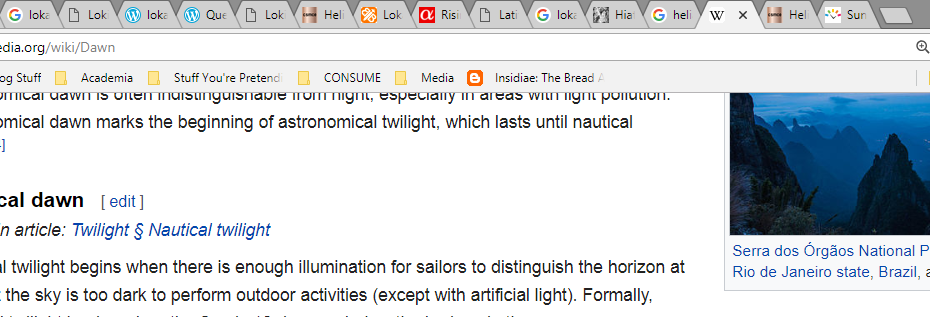
There’s a handful of tools available that will vastly simplify the process for you. The one I am most familiar with is the Heliacal Rising Simulator, which allows you to punch in your latitude, choose from marking twilight (astronomical) or sunrise as a frame of reference, and fiddle with a date slider to figure out which date most closely aligns with Sirius’s heliacal rising. I would recommend dawn as your frame of reference, though nautical or civil dawn may be more practical than astronomical dawn.

There will be many, many tabs open while you research this.

SO MANY TABS
UuuuuUUUUUUUUGUHGGHGHHG

It will be worth it. I promise. There is nothing quite like witnessing a star’s return for yourself. And then you have the added benefit of having a whole bunch of free time, because you got up before the sun.

So when you’ve picked your date and you’re ready to head out, brew yourself a big pot of coffee. Pour Loki a cup while you’re at it.


I’ve noticed that this post has been the biggest driver of traffic to this site. If you find my work helpful, and as long as you are in a position to give, please consider dropping something in my tip jar.

Buy Me a Coffee at ko-fi.com

A Random Theory About Útgarða-Loki

Disclaimers are important! So here’s mine. I am not an expert on Norse mythology. I am just a Heathen who moonlights as a big old nerd, and tries to read very old pieces of text until I am very mad about everything and start chugging mead in frustration. (I am inflicting this suffering on myself right now with scans of Computus Runicus.)

ALSO, because I am not an expert, with a robust scholarly background, and I am also not anywhere near old enough to have been around for when Haustlong and the chunk of the Prose Edda about it was written, this should be regarded as a curiosity. I have a post on that, too.

ANYWAY.


In the post about the Snaptun stone I took a guess that the story of Loki/Logi/Útgarða-Loki was originally a poem. Not just because the Prose Edda is Snorri transcribing linear narratives from poems, but because of the sheer amount of alliteration in the use of these names.

We don’t seem to have any traces of this poem beyond the narrative, if it exists. Snorri does not quote stanzas from wherever he is getting this story. So the claim that this is a poem is a logical–but technically unprovable–guess.

I’m going out on a limb that I desperately hope will hold my weight, is what I’m saying.

Útgarða-Loki might not be a name. In fact, I strongly suspect it’s a kenning. It even follows the standard format of genitiveY-nominativeX used in kennings (“Loki of the outer yards,” in this case) to obliquely refer to something that wouldn’t have otherwise fit the style a poet was using.

The thought occurred to me when I was skimming something for another post and noticed kennings such as “ale-Gefjon.” But Ale-Gefjon isn’t literally Gefjon doling out alcohol. It’s Groa. There is no room in this narrative for Gefjon’s actual presence, let alone her doling out ale.

Gefjon’s name is used here as a general placeholder for “woman.”

So I imagine it’s well within the realm of possibility that Loki’s name could have been used similarly. Maybe, just maybe, “Loki” in the potential kenning “Útgarða-Loki” is being used as a placeholder for a Jotunn in general, or a deceiver in general.

Like Loki, Útgarða-Loki weaponizes the neutral. (Fire, thought, age, the sea; whereas Loki weaponizes speech and–depending on source–mistletoe.) He deceives the gods who wander into his territory. His deceit unravels. And in this story, Útgarða-Loki is the driver of conflict and the mover of the narrative. Compare this to the “mover of stories” function that Yvonne S. Bonnetain ascribes to Loki–you can read a translation of the summary here.

He takes on the role that Loki ordinarily fulfills in his tales. But he is a total outsider from the perspective of the gods and the skalds that center their narrative. While Loki is considered somewhat of an outsider, and a transgressor, he is counted among the Aesir and is portrayed as belonging in Asgard. Útgarða-Loki is not.

And he is not Loki, himself. Just similar.

I’m not invoking the overblown and ridiculous innangard-utangard dichotomy, by the way. That concept is a wild misinterpretation of the actual concepts of whether something falls within, our outside of, a given boundary. Usually a fence. A house. A town. Útgarðr can be a little more ~woo~, but mostly just conveys an idea of something being “way over yonder.”

The actual identity of Útgarða-Loki has not been definitively solved. I am nowhere near qualified to definitively solve it–and that’s not how it works, anyway. This is just my two pieces of hacksilver.


Buy Me a Coffee at ko-fi.com

“Loki Did It!”

For most of us, pop culture and kid-friendly reinterpretations of mythology are the very first exposure to pagan deities. With that comes a lot of oversimplifications and misinterpretations of their stories, so that they fit more comfortably into modern biases and are easier to understand.

The downside of this is that people tend to lock in on first impressions, and therefore they lock in on the oversimplifications. Speaking for myself, Loki was that weird guy who made mischief, and who forced Jim Carrey to behave like…well, Jim Carrey, but cranked to 11.

The Mask (and the majority of his other portrayals) really didn’t care to go into the complexity of the Trickster archetype, or the fact that Loki isn’t quite a trickster–he deviates strongly into and out of quite a few archetypes.

And I think it’s the oversimplification of Loki’s character that sets people up with the wrong idea about what Loki actually does to, for, and with humans.

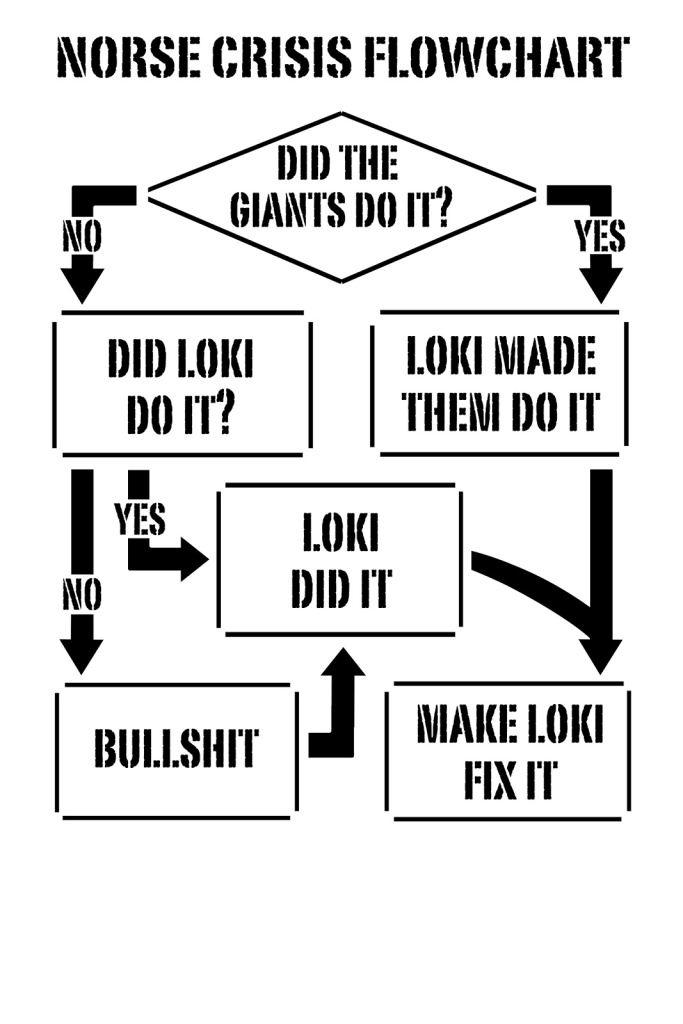
Which leads to a lot of annoyances and bizarre incidents being chalked up to “Loki did it!”

norsecrisisflowchart
via Myths Retold

Computer glitching? LOKI DID IT. Power went out? LOKI DID IT. Vase fell off the table when you bumped it? LOKI DID IT. It snowed and now you have to shovel your driveway? LOKI DID IT, even though that’s more of a Thorri and Skaði thing. Souffle deflated? LOKI DID IT. SHOULDA GIVEN HIM SPONGECAKE.

It saves time, I guess, but it reflects a lack of discernment and doesn’t acknowledge Loki as a complex being–despite his being defined by complexity.

There have been incidents where it was extremely obvious that Loki was doing something. I’m talking about the falcon thing, or dropping feathers in my path. Or the time he threw a turtle shell off of the bookcase where I keep my shrines, after I blew out a candle I knew he wanted lit. Or breaking my bed. (There’s a whole story on that, but since it happened on Christmas, the post is queued for December.) Or the time he responded to my constant demands that he “teach me something,” by knocking a carton of eggs out of my hands. I learned that you can’t get egg whites out of an unsealed wood floor, and to be less of a nag.

There were also less obvious incidents that snuck up on me long after the fact–like the feather thing, initially, because I was unaware of the folk tradition claiming that he “harvests” feathers from birds.

None of these things were random, daily annoyances. Most of them weren’t even inconveniences, really, except for the egg incident and the bed incident. With the sole exception of the feather thing, probably, they all happened in situations that directly and unambiguously involved him. He was either initiating or continuing a conversation. Something was being communicated.

That’s a big part of why, even with my persistently glitchy keyboard problems, my instinct isn’t “Loki must be doing this.” My laptop is a workhorse that runs resource-intensive programs on a regular basis. I spilled a large jar of water on it back in 2014. I’ve spilled the juice for my e-cig on that keyboard more times than I can count. And it wasn’t during interactions with Loki, but just me minding my own clumsy business. Of course the thing’s acting weird. It’s a miracle it still works at all. If there was somehow a hidden message in my laptop ghost-typing 8’s and +’s all the time, I wouldn’t be able to decipher it, anyway.

So, no. Let’s not blame things on Loki without checking the context first. The Norse Crisis Flowchart is not a substitute.


Buy Me a Coffee at ko-fi.com

On the Responsibility of Harsh Truths

It is often said that Loki is a bringer of harsh truths, as shown in the Lokasenna and the personal experiences of his devotees. Hence, his title of bölva smiðr, bale-smith. One who crafts those things that hurt to hear.

I don’t doubt this. I’ve experienced it directly.

It is also said by many of these same people that it falls to us, as Lokeans, to also bring harsh truths.

This gives me pause, for several reasons.

For one, Loki, as a god, is ancient. He has been given thousands of years (at minimum) to observe the follies and vanities of his peers and of humans. He knows how we tick. Our human lifetimes are fairly long, at 80+ years in a sufficiently cushy environment. But they’re still astronomically shorter than a god’s lifespan. We have far shorter windows of opportunity for studying each other, and we have to develop ourselves simultaneously. It’s a lot to juggle at once.

By extension, while our gods are fallible, they are more experienced and more mature than we, as humans, will probably ever get to be. They can spot our dishonesty and our arrogance faster than we detect it in others, and especially in ourselves. This is what harsh truths, by necessity, destroy.

Picture someone you know who pointedly announces that they are honest. When they insult you or talk down to you, their excuse for this behavior is that they’re just so honest. They call them as they see them. Fine, I guess. But what does that achieve? Did you actually learn something useful about yourself? Does this person examine their own worldview like that?

Doubtful. These kinds of people are usually just annoying and making excuses. Also, stop befriending whale biologists.

Unlike your average “but I’m just being honest!” type, Loki is tactical. This is literally the minimum requirement for a trickster-adjacent god. (“Trickster” is a bit of an oversimplification, but that’s for another day.) You don’t get a reputation for being cunning and sly if you don’t exercise good judgement. Good judgement does not have room for arrogance, vanity and just plain being a dick.

Loki is also accountable, whether he likes it or not. When he suggests letting the giant builder use his horse, it’s him who has to go sabotage the wall to save The Sun, The Moon and Freyja when this proves to be a bad idea. When he tries to get out of surrendering his head to the dwarves who crafted Mjölnir, his mouth is stitched shut; by refusing to pay the promised fee, he opens himself up for punishment. The Lokasenna ends in his punishment, too, even as he spends several stanzas calling his peers out on their faults. (I also think it’s easy to forget, in this day and age, that Lokasenna is a comedy piece.) He tries to wiggle out of both of these, literally in the second case, but to no avail.

In short, our actions have consequences.

I don’t think we do justice by this supposed obligation to the harsh truth when we are not tactical and accountable. We are not tactical if we call them as we see them, every time we see them. There are time, place and manner considerations. Power dynamics do not magically melt away, and if we take this task seriously, we must also be ready to face the consequences of uttering these harsh truths. Reactions are not always justified, but they’re harsh truths. They will rarely, if ever, be received well.

And maybe harsh doesn’t suit the situation. Maybe it’s not even our job, because not all of us are qualified. Maybe it’s a skill that has to be developed.

We must also be similarly willing to turn this on ourselves, because if we don’t examine and work on ourselves, work on our natural impulse to stir the pot before figuring out if it really serves the greater good, we can’t trust that the message is given in good faith. We have to be ready to ask ourselves why this needs to be shared, what good it does, and if we’re ready for the consequences. How can you know you’re telling the truth to others if you’re still lying to yourself?

I don’t want to imply that I am somehow immune to this, either. The entire point is that nobody is. We will probably never ditch the instinct for arrogance, but we can at least be aware it’s there, so we’re prepared to resist it.


Buy Me a Coffee at ko-fi.com

A Few Favorite Examples of Norse Mythology and Culture in Media

The Almighty Johnsons

This is a show that takes place in modern-day New Zealand. The main premise is that there are families descended from Scandinavian immigrants, who carry on a tradition of serving as vessels for Norse gods.

The focus is on the Johnson family and their Norse god hijinks, but there are also major Māori characters whose portrayals are about on par with the Johnsons and other “Norse” characters. Every major character is well-developed and charming, even if most of them are jerks. (Except the guy who carries Loki. He’s pretty much just a jerk.) Even minor characters get to experience significant development as the series goes on.

And without giving too much away, there’s an important plot involving the gods-as-humans dynamic with Māori deities, and a main character’s mixed (and hidden) family origins.

There are moments where this show can be insensitive at best. More eye-rolling casual misogyny than I’m usually comfortable with, for one. And there are instances of casual racism in the show coming from the Scandinavian-New Zealander characters regarding Māori characters. But that plot is an important exploration in who has the right to approach–or be, in this case–a Norse god. As it turns out, “purity” isn’t an issue and the gods pick the person after all. It’s a show that will ultimately piss folkists off, and there’s a lot to love about that.

I’m not sure where else to get it outside of New Zealand, but it’s available on Netflix here in the US.

Norsemen (Vikingane)

This one is probably best suited for people who like Vikings, but prefer slightly more historical accuracy, and humor over drama. This is a Norwegian show which takes place in the Viking age, and was simultaneously recorded in spoken Norwegian, and English. The first season of the English-language version is available on Netflix.

A lot of the humor in this show is graphic and rather edgy, with jokes that rely on death, injury or casual treatment of rape. (Which, luckily for this show, fit the setting well enough to fly–the 790s were rough.) But there are also moments with extended jokes that obviously required research, like an almost-lawyerly insistence from a character that he was totally the active partner, and therefore bottoming wasn’t ergi.

I don’t normally go for edgy humor unless it’s equal-opportunity, self-directed or expertly done in the correct context. Norsemen has managed to meet those standards, though I do still have some issues with language that uses disability as insults. No media is perfect.

Peter Madsen’s Valhalla

Given some news articles from the past few months, I feel the need to specify that this is not the Peter Madsen who did that horrible thing involving a submarine.

Valhalla is a 1986 animated film based on Peter Madsen’s comic series of the same name. The movie focuses on the Gylfaginning, specifically the passage which describes Thor gaining Thjalfi and Röskva as servants, and their contests with Útgarða-Loki.

With the exception of Quark–an original character from the series–this is one of my favorite animated movies, and especially one of my favorite movies that involves Norse mythology. It’s definitely geared towards children, but cuteness and humor don’t actually have an age limit. And while it takes a few liberties regarding characterization and plot, it does a really great job of being loyal to the source material.

Also, the soundtrack is great.

It’s hard to get hold of a copy of this film. I have yet to find a DVD available, though you can still buy Madsen’s comics. Your best bet is probably finding a stream online. Not ideal, but short of petitioning for DVDs in multiple region formats, there’s not a whole lot else to be done.

“A Kick in the Asgard,” from The Grim Adventures of Billy and Mandy

Once upon a time, this show was a double-feature called Grim & Evil. I actually liked the Evil con Carne half better, but I was clearly in the minority seeing as they dropped it.

In this episode, Billy is swapped with a very high-strung Einherji who decapitates topiary, and angrily mumbles in what I can only describe as the “Sesame Street” dialect of Old Norse.

Having taken his place in Asgard, Billy gets a quick tour of Valhalla. Odin introduces him to Thor (who is, I think unfortunately, really obviously based off of Marvel), and Loki, who has bright red hair and shoots rubber bands at people.

Everyone is wildly out of character, except maybe Loki, but the entire thing is absurdist anyway. Asgard doesn’t have a rootbeer fountain.

Would be cool if they did, though.

On DVD, you’d be able to get this episode with anything that has season 3 on it. But the whole thing is on YouTube, too.

Not Quite There, but an Honorable Mention: Overwatch

So…there are no actual figures from Norse mythology, or portrayals of Old Norse culture in Overwatch. But the game has a few references to Norse mythology!

For example, Torbjörn is a person of very short stature with a knack for tinkering, in an obvious reference to the duergar of Norse mythology. And his name even means “Thor-bear!”

I strongly suspect Junkrat is also inspired by Norse mythology–or at least, later interpretations of it. His character design is very similar to the way Arthur Rackham drew Loki in his illustrations for “The Ring of the Nibelung.” These images came after the misconception of Loki being a fire deity took hold and spread, so a character designer looking at fire-related imagery for a pyrotechnic (and pyromaniacal) character would be forgiven for picking up that influence.

And I’m willing to tolerate it, because it’s a pretty niche artistic shout-out, and Junkrat has some very endearing trickster traits.


Buy Me a Coffee at ko-fi.com

Reporting on Heathenry, Responsibly

This would probably be considered a companion post to the role we can play in improving the image of Heathenry.


We know Heathenry has a racism problem. Anti-racist Heathens, myself included, consider this a significant problem that needs to be addressed. Our religion continuing to be hijacked by extremists, violent gangs and white supremacists is a really big deal.

But I am conflicted about the way journalism portrays Heathens. Racism seems to be all anyone wants to focus on, even though there’s a whole lot more going on. Most of the time I find a news article about a Heathen that’s not from a specifically pagan-geared source, it seems the writers go out of their way to mention–or talk to–the racist Heathen contingent.

Take Dylan Sprouse, who may very well be the most visible celebrity Heathen. Here’s an interview about when he started a mead brewery.

Somehow the writer thought it was necessary to drag in a mention of Stephen MacNallen, even though Stephen MacNallen has nothing to do with brewing mead. The writer openly admits that Sprouse satisfactorily addressed their concerns, and still brings it up anyway.

And sure, Sprouse citing his ancestry as what drew him to the faith can signal a cause for concern. It’s certainly one of the doors where racists get in, and we should be mindful of that.

But there are plenty of decent, inclusive and perfectly safe Heathens who are drawn to Heathenry by that, or who discover it after the fact–including Heathens that are as anti-racist as you can get. That is a very different phenomenon from saying only people with the “right” ancestry are allowed to participate. The former is an interesting coincidence, the latter is blatant racism.

These things warrant further investigation, not leaping to formulaic conclusions.

In the spirit of investigation, I scoured Dylan Sprouse’s social media for this post, using the same metrics I use for evaluating whether any other heathen is “safe.” I like to think I’m pretty good at picking up on signs of danger like that, and I turned up absolutely nothing. The only troubling thing I found was that he loves Hidden Valley Ranch dressing way too much.

And that’s not even harmful, it’s just…odd. Like, I checked. Ranch dressing isn’t a known dogwhistle for anything. He just really, honest to gods, loves ranch dressing.

Journalists approaching Heathenry also seem to give more text and time to folkists and white supremacists. That one recent New York Times article (“Who Owns the Vikings?”) was a particularly infuriating example. It failed to even answer its own question about who Heathenry belongs to (though I recognize that it is usually editors, not writers, who choose the headline), and spent most of the article length talking about the nationalist Heathen group. Somehow the article had room for an unfinished tangent about recruitment in farmer’s markets (?), but not enough for more than a few token paragraphs about Forn Sed–the vastly more progressive group of the two mentioned in the article.

I am angry about it.

Inclusivist and anti-racist Heathens exist. Often loudly. We go out of our way to educate people on why racism has no place in our faith, and to drive the point home that Heathenry is wide open for anyone willing to do the work. We have exhaustively explained, time and time again, exactly why Heathenry is open. The bolder among us take it upon themselves to confront racist Heathens more directly.

We don’t do this for our health, and we sure as Hel don’t do it for fun. We do it because it’s important, and it’s unfortunately necessary.

So why aren’t they talking to us?

The things that scare us also tend to fascinate us. I suspect that is what drives that tendency to bring up or focus on extremists, no matter how irrelevant they are to the actual subject matter. Journalists are human, and racism is frightening. Rightly so. Nobody should be comfortable about something that is objectively dangerous.

But journalists are also professionals with a responsibility to tell the truth, or at least be sincere about their biases, and to be fair and balanced in their coverage.

When journalists fixate on interviewing nationalists and supremacists, they amplify those voices. They help that agenda spread, and they do this at the expense of progressive voices actively working against it. This is in spite of inclusivist Heathens actively reaching out to journalists to provide fact-checks and guidance. When journalists mention racist Heathen organizations and gang activity apropos of nothing, they actively participate in conflating our religion with violence and destruction.

Heathens do not have the benefit of widespread social acceptance. Nor do we have strength in numbers, with a diffuse worldwide total in the lower tens-of-thousands.

I hesitate to say that Heathens are oppressed. In the US, there are no laws that meaningfully restrict my religious practice. My neighbors know of my faith, and don’t feel compelled to cause me trouble. Nobody has physically assaulted me because of Heathenry’s association with racial terrorism. My family and friends have not disowned me. Your mileage may vary on that last one, because it’s a surface-level form of aggression, and very easy to do.

We are, however, definitely marginalized on the basis of numbers, and the lack of awareness and acceptance that go with it. Actively perpetuating a stereotype does nothing for us, and works against us.

Failing to do the research and make the effort is irresponsible.


Buy Me a Coffee at ko-fi.com

Let’s Talk About Incarcerated Heathens

The general population does not have a very high opinion of people who are, or have been, in prison. I remember being as young as 12 and hearing rumors about plastic surgery, niche therapy and otherwise non-essential care being provided to people on death row. These were all told with the heavy implication that these people are worthless and have it “too good.”

The reality is very different. There’s hoops to jump through just to get a tooth pulled, no matter what your conviction was about.

This perception doesn’t improve once people are released. Employers often refuse to hire convicted felons, but having a steady job is a requirement of parole in most areas. Being in prison leaves large gaps in your life that are, at best, awkward to explain. There is a huge social stigma attached to it, which creates a serious barrier to resuming a normal life. Incarceration often traumatizes people, creating yet another barrier to reintegrating with society because trauma is a profoundly alienating and lonely experience. It’s really not surprising in these circumstances that over half of all people released from prison eventually go back, often for a parole violation. Personality and habit alone do not explain this.

The prison system theoretically isn’t supposed to make people magically disappear. But a lot of people behave as if they assume or wish this were the case.

One would hope, as members of a religious minority that is often either invisible or stigmatized, we’d be a little more charitable to people paddling up the same creek in a different boat. This is not often the case. Obsessive Tru Warrior types are all too glad to slap these people with the label of níðing, proclaim them oath-breakers and discard them as dishonorable.

I hate this approach.

The vast majority of people sent to prison are eventually released. Approximately 90% of all people currently in prison in the US will eventually leave it. That means that many Heathens in prison right now, statistically speaking, will eventually be back in our communities. We can choose to make that our problem, or make it an opportunity. Either way, it is of our concern.

There is also a strong tendency among the prison population to become religious. It is vital for people in prison to have some kind of support structure, and anyone involved in Heathenry (on the inside or outside) can attest that the gods and a good community do wonders for our well-being. Remember how I said over half of all people released from prison eventually go back? The rate of recidivism is lower for inmates who receive competent religious or spiritual care. Religious organizations have an incredibly important role in the reintegration process, and society directly benefits from ensuring that incarcerated Heathens have these needs met.

This is true of all faiths, but Heathens in particular are under-served.

There’s a few complications with resolving this, as with anything. A declaration of faith often dictates your social circle in prison, and there’s a definite correlation between white supremacy and putting some form of Heathenry on your paperwork as a result. This is made worse by the fact that various racist organizations both in and outside of prison feed off of this. And then the DOC shuts down Heathen volunteer programs out of (unfortunately, justified) concerns for gang activity.

For sincere Heathens who aren’t seeking community for a social life or an ego trip, but out of devotion for the gods, this sucks. Prison is not a pleasant place to be. It’s not meant to be, but these Heathens are denied a very necessary service that would drastically improve their experience and behavior on the inside, and their chances upon release.

Because, yes, on top of reducing recidivism rates, competent spiritual care reduces the number of infractions while in prison.

Universalist/Inclusive Heathens have an important job to do when it comes to reducing the amount of racism in our religion. Tactics may differ, but they all require work. Prison ministry is a valuable opportunity to redirect people in a bad situation to a healing and progressive framework. Even if we can’t make people stop being racist, supporting inclusive Heathen prison ministry at least means we have a better chance of preventing further indoctrination from Heathen organizations with a malicious, racist agenda.

Robert L. Schreiwer tackles this in the In-Reach Charter (all emphasis mine):

*Whether inmates have access to positive Heathen influences is part of a larger issue that has an impact on the whole of the Heathen community.* In many cases, the perception of Heathenry is defined by radical racist elements from the prison population.

The administrators are not blindly or randomly inventing their perceptions; the perceptions have formed from the presence of race-based books, tattoos, and gang behaviors that have been found among the Heathen prison population. A radicalization based on race and/or ethnicity is taking place in some facilities. When these radical racists are released into the general population, the history of their experience and influence will become an even bigger problem for us than it is now. Thus, *prison outreach efforts are a frithful move to protect the folk from this destructive radicalization.* This program meets a need that supersedes the unpaid debt of individual prisoners.

Programs like In-Reach have stepped up to the plate, now armed with this knowledge, and with the goal of ensuring that incarcerated Heathens have competent spiritual advisors. Appalachian Pagan Ministry is doing the same.

This is a big part of why pursuing ordination is one of my major life goals. This kind of work is immensely important.


Buy Me a Coffee at ko-fi.com

Old Gods, New Tricks

Recently, as I was stuffing pork bones into a ziplock to make soup later, my dad said “you’ve become such a homesteader!”

Since I don’t have an actual backyard farm or a little house on the prairie, I asked “how so?” To which he replied “well, trying to grow food, cooking everything from scratch, making bone broth, whittling and chopping wood, this Old Norse thing.”

And…he’s not wrong. I did end up Googling the money and space required for having a small flock of sheep later that day, since my absurd backup life goal is becoming a shepherd. As it turns out, it’s roughly 1,000 USD before fencing and maintenance costs, and five ewes would fit comfortably in the front yard. So I have the space, but not the budget.

In talking to other Heathens, I’ve noticed there’s a definite trend to become a little old fashioned. But in a wholesome and self-sufficient way by picking up forgotten skills, as opposed to nostalgia for an age that never existed. We have a high proportion of artisans, brewers, fiber workers, accomplished home cooks and backyard farmers. Some of us end up being bushcrafters and preppers. And this usually kicks in after being scooped up by the gods, with surprising regularity and frequency.

It’s happened to me, as well. I had been cooking from scratch and playing with yarn for a while, but the desire to make my own Sauerkraut, naalbind, work with wood and contemplate spinning my own yarn (while possibly raising sheep for the fiber) came after Heathenry.

While I wholeheartedly believe the gods are willing to adapt a bit to our modern life (especially considering the internet is the best recruiting and networking tool for Heathenry), they seem keen on us being as handy as possible.

I doubt this is doomsday prep. Odin’s concept of that is wandering around and picking up esoteric wisdom, not stockpiling non-perishables. Considering the survivors of Ragnarok are already pre-assigned, I’m not sure how much good rice and chocolate bars would do you, anyhow. And I doubt that our gods would nudge such creatures of habit as humans to alter our lifestyles for the aesthetic. It’s not a compelling reason and doesn’t add a whole lot to our personal development. Ask any former mallgoth.

Some of this can also be easily explained by a stronger tendency among pagans for environmentalism, frugality and being more mindful about our use of resources–which all lead to a lot of the same behaviors.

We also, for many of the same reasons we gravitate towards otherwise forgotten faiths and gods, have a fondness for history. Depending on your path, you’re likely to be doing a lot of research anyway, so it stands to reason that you’d come across a lot of older skillsets in that process.

Are we just trying to get in touch with something archaic on our own, because we find it interesting? Because the land is frequently part of our spirituality? Because we think it gives us better insight to how the people who originally honored our gods lived?

Better insight to the gods themselves, even? Skills like fiber spinning, animal husbandry, farming and brewing were utterly vital to human survival before mass-production. And the same mentality applied to the gods. It makes sense, then, that it would have been considered laudable and sacred work. Hence, the importance of Frigg, Thor, Frey and Aegir as participants in, and representations of, that work.

Perhaps our gods nudge us towards it, as part of a larger scheme to develop us as humans. To make us more capable, more productive, more contemplative. To connect us with history, for the sake of a better understanding of our place in the big picture.

I don’t know for certain. And to an extent, I suspect that is particular to the god and devotee, as well.

All I know is, the gods have kind of ruined modern life for me, in the best possible way.


Further reading (and watching):

Spin Like a Viking,” by Lois Swales on YouTube

Vikings Didn’t Knit! (Nalbinding)” by Good and Basic on YouTube


Buy Me a Coffee at ko-fi.com

Heathenry Changed Me–For the Better

Obviously, all religions come with certain expectations about conduct. There will probably always be disagreements about the finer points, but there are still overarching themes. There are certain rituals and observances with traditions you’re at least implicitly expected to use. Or to find a sufficiently similar approximation.

But major lifestyle changes? Heathenry doesn’t have a whole lot in the way of dogma, and explicitly didactic stuff like Havamal is mostly common sense, so I didn’t expect any major changes. They happened anyway.

When I swore my pledge in preparation for a lifelong oath, one of the requirements I set for myself was that my oath ring had to be on during waking hours, and other religious jewelry should ideally be worn, especially if I was leaving the house.

For the first two weeks, I didn’t wear my oath ring to bed. The natural chemical balance of my skin runs acidic and salty, so it tarnishes every metal I wear, except for stainless steel. (Probably purer gold alloys, too. But I don’t wear gold. Sorry, Gullveig.) My oath ring is made of copper, so I kept it on the altar to prevent my skin from damaging it, and because I was paranoid about rolling over on it and snapping it. This meant climbing out of bed as soon as I was alert, so I could put everything on.

I used to wake up at a pretty normal time, but then spend several hours catching up on social media, sneaking naps, and collecting myself before finally making coffee around 11AM. Putting myself in a situation where I had to get out of bed the instant I realized I was awake has forced me to start my day earlier. I may still crawl back into bed to stay warm and check feeds, but I definitely start my day a few hours earlier and catch myself looking for ways to get a head start on being productive. I suddenly have so much more time to get things done.

And considering I have ADHD, which often comes with bizarre sleep issues (more on that here) this was a feat. I have struggled for years to keep myself up at a “normal” time. Now that I’ve managed it, I crave it. Melatonin and coffee are still useful things to have on hand, and I’ll throw in the occasional nightcap, but these are all in pursuit of a functional relationship with sleep and daylight.

Religion has also nudged me into being more active. When I didn’t have the budget or the craft skills to dress up my shrines to my liking, I relied on found objects picked up on walks. I was walking upwards of 7 miles a day to collect cute rocks and offerings. I’m out of shape at the moment, but now that the weather’s a little kinder I’ll be right back to that level in no time flat.

There’s also a lot more emphasis on trying to be self-sufficient and resourceful. Part of that was downsizing to identify a manageable workload. The rest of it was picking up new skills and advancing the ones I already had. If you can cook well enough for yourself when you were used to prepackaged food, that’s an achievement on its own. But when you cook for the gods, the pressure is on to make more exciting choices and expand your repertoire.

And when idols are pricey to buy, and the ones on the market don’t suit your style, the next logical step is to figure out how to make your own. Which, incidentally, made me far more motivated to tidy up the yard in search of workable wood and finally learn how to properly work an axe.

Being a heathen has also drastically altered my relationship with alcohol. I was never an alcoholic (thank the gods) but I had a horrible tendency to binge and get blackout drunk on the rare occasion that I did drink. If I bought alcohol, it was a matter of finding the balance of a tolerable flavor, good price and sufficiently high %ABV. If someone else provided it, and didn’t intervene, I’d just grab whatever they permitted. I didn’t drink for pleasure. I just drank to get drunk.

You’d think, from the outside, that heathenry would encourage drinking, since it’s frequently included in our group rituals and we take our cues from the supposedly very sloshy Vikings. The Hávamál suggests something pretty different, though:

[12] Less good there lies | than most believe
In ale for mortal men;
For the more he drinks | the less does man
Of his mind the mastery hold.
[13] Over beer the bird | of forgetfulness broods,
And steals the minds of men;
With the heron’s feathers | fettered I lay
And in Gunnloth’s house was held.
[14] Drunk I was, | I was dead-drunk,
When with Fjalar wise I was;
‘Tis the best of drinking | if back one brings
His wisdom with him home.

Bearing in mind that alcohol snatches your wits has made me more likely to refuse, even when the opportunity is right in front of me at no apparent cost. Faceplanting on walls isn’t a good look. And I’m sure the gods find it funny, but what’s funny once is just really sad when you do it regularly. The real cost is a lot higher than what’s immediately obvious.

Which is something that having my fingertip crushed in a door during a bender put into painfully sharp focus.

So, I take the apple juice instead of the wine. Make instead of buy. Try to sleep and try to be mindful of my consumption and be generous with what I have. Try to be whatever it is the gods seem like they’re nudging me towards.

Wild goose chases aside (tricksters gonna trick), they haven’t really led me astray so far.


Buy Me a Coffee at ko-fi.com